Focused vs. Radial Shockwave Therapy
If you’ve been researching options for a stubborn tendon injury, chronic heel pain, or a condition that just won’t heal, you’ve probably come across the term “shockwave therapy.” Maybe your orthopedic surgeon mentioned it. Maybe you found it while searching for alternatives to cortisone injections or surgery. Here’s something most people don’t realize: not all shockwave therapy is the same. There are two fundamentally different types — focused shockwave therapy and radial wave therapy — and understanding the difference matters. At CT Sports Recovery in Westport, CT, our physician-led team serves patients throughout Fairfield County using both technologies, applied strategically to reach the tissue that actually needs treatment.
What Is Shockwave Therapy, Exactly?
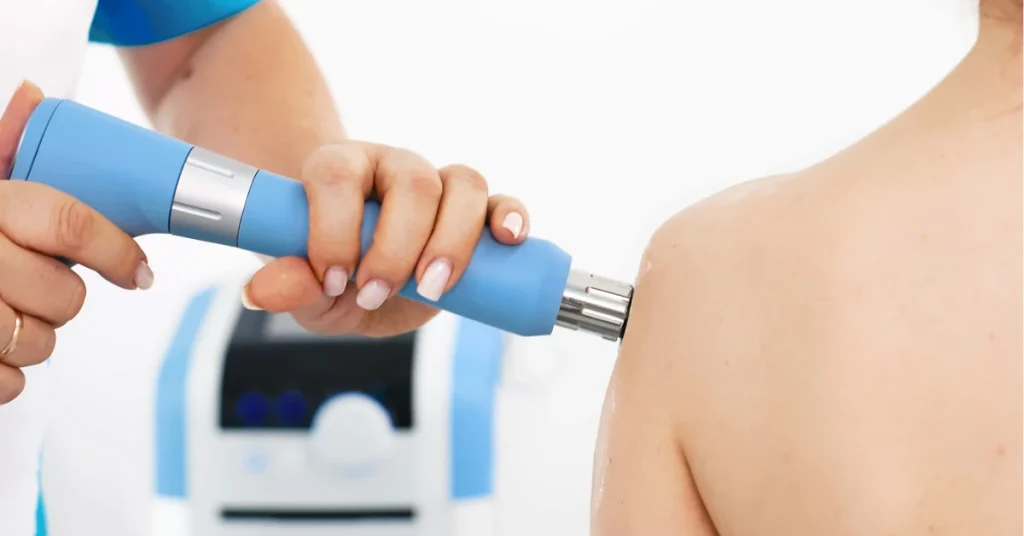
Shockwave therapy has nothing to do with electrical shock. The word “shock” refers to acoustic pressure waves — high-energy sound waves — delivered into tissue using a handheld device applied to the skin. These pressure waves interact with tissue at a cellular level, triggering biological responses: stimulating the production of new blood vessels, activating cells responsible for collagen repair, breaking down calcifications, and modulating pain signals.
The result is accelerated healing in tissues that — particularly tendons and ligaments — often have poor blood supply and struggle to repair on their own. Shockwave therapy has been studied extensively for decades and is recommended in clinical guidelines worldwide for conditions like plantar fasciitis, Achilles tendinopathy, and calcific tendinitis of the shoulder, often as the preferred non-surgical option before more invasive interventions.
But the key to whether shockwave therapy actually works is how those pressure waves are delivered.
Radial Wave Therapy: The Broad Approach
Radial wave therapy — sometimes called extracorporeal radial pressure wave therapy — generates pressure waves at the tip of the device that spread outward in a cone or radial pattern, like ripples expanding on water. Energy is highest at the skin’s surface and decreases as it travels deeper. By the time the wave reaches a deep tendon, joint, or calcification, a meaningful portion of its energy has already dissipated.
Radial wave can be effective for superficial conditions, including tight muscles, surface-level trigger points, and some cases of plantar fasciitis where the tissue sits close to the skin. It is widely available and easy to operate.
However, it has real limitations:
- It cannot reliably deliver therapeutic energy to deep structures
- It is less effective for tendons, bursae, or calcifications more than a few centimeters deep
- It operates at lower energy levels overall
For many patients who tried shockwave elsewhere and felt it “didn’t work,” the therapy was likely radial wave that simply never reached the target tissue.
Focused Shockwave Therapy: Precision at Depth
Focused waves are generated and then converged — like a lens focuses light — to a precise focal point deep within tissue. This delivers a concentrated, high-energy pulse exactly where it’s needed: a deep Achilles tendon, a rotator cuff calcification, a hamstring origin deep in the hip, or a point of degeneration in a patellar tendon.
Focused shockwave therapy offers several advantages:
- Greater depth of penetration — 3 to 12 cm beneath the surface, far beyond radial wave at therapeutic energy
- Higher energy delivery at the target, driving angiogenesis, robust collagen remodeling, and disruption of calcifications
- Precision targeting to the exact anatomical structure involved
- A stronger evidence base for chronic conditions — for the most treatment-resistant tendinopathies, research consistently shows superior outcomes with focused shockwave compared to radial


The Strongest Approach: Both, Together
Focused and radial wave therapy are not competing technologies — they are complementary. Used strategically in the same session, they address different aspects of the same problem.
Focused shockwave does the deep, targeted work — stimulating repair at the core of the injured structure, disrupting calcifications, and driving angiogenesis at depth. Radial wave treats surrounding tissue, addressing muscle guarding, fascial restrictions, and surface-level inflammation.
Chronic injuries rarely involve just one layer of tissue. A patient with Achilles tendinopathy, for example, typically has degeneration within the tendon body, inflammation at the tendon sheath, tightness in the calf, and sometimes fascial restrictions extending into the foot and lower leg. By combining focused and radial wave therapy, CT Sports Recovery is able to treat the full picture, not just one layer of it.
Conditions That Respond Well to Combined Shockwave Therapy
- Plantar fasciitis and chronic heel pain (success rates of 70–80% in research trials)
- Achilles tendinopathy (mid-portion and insertional)
- Patellar tendinopathy (jumper’s knee)
- Calcific tendinitis of the shoulder
- Tennis elbow (lateral epicondylitis)
- Golfer’s elbow (medial epicondylitis)
- Greater trochanteric pain syndrome (hip bursitis)
- Hamstring origin tendinopathy
- Tibial stress reactions and shin splints
What to Expect During Treatment
A combined session typically takes 15 to 30 minutes. After a brief evaluation to confirm the target structure, coupling gel is applied and the focused device is positioned using anatomical landmarks.
Most patients describe the focused wave as a deep, rhythmic pressure — firm but not typically sharp. The radial portion feels more diffuse and vibrating. Mild soreness for 24 to 48 hours after treatment is common and normal.
Typical Treatment Timeline
- Most protocols involve 3 to 6 sessions, spaced about one week apart
- Tissue remodeling continues for weeks to months after treatment
- Many patients see their best results 6 to 12 weeks after completing the protocol
A Note on Why This Matters
A common thing new patients say is, “I tried shockwave somewhere else and it didn’t help.” Almost without exception, the device used was radial wave applied to a deep structure it simply couldn’t reach. This isn’t a criticism of practitioners using radial devices — the term “shockwave therapy” covers a wide range of devices with very different capabilities.
If you were told shockwave “doesn’t work,” it may be worth asking what device was used, at what energy level, and whether focused shockwave was part of the treatment. At CT Sports Recovery in Westport, Connecticut, our physician-led team uses a combined focused and radial protocol, individualized to your condition and tissue depth.
Frequently Asked Questions
- What’s the main difference between focused and radial shockwave therapy? — Radial wave disperses energy outward from the device tip and works best on superficial tissue, while focused shockwave converges energy to a precise point 3 to 12 cm deep, making it far more effective for deep tendons, calcifications, and chronic injuries.
- Why didn’t shockwave therapy work for me somewhere else? — In most cases, the device used was radial wave applied to a deep structure it couldn’t reach with therapeutic energy. Ask what device and energy level were used, and whether focused shockwave was part of your treatment.
- Where can I get combined focused and radial shockwave therapy near me in Fairfield County? — CT Sports Recovery is located on Main Street in Westport, CT, offering physician-led, individualized shockwave protocols to patients throughout Fairfield County, including Norwalk, Fairfield, Weston, and Wilton.
Find Out Which Shockwave Approach Is Right for You in Westport, CT
If you’re dealing with a chronic tendon injury, calcific tendinitis, or heel pain that hasn’t responded to other treatments, the type of shockwave therapy you receive matters as much as the decision to try it. Contact our Westport team to schedule an evaluation and find out whether a combined focused and radial shockwave protocol is right for your condition.
CT Sports Recovery — Recovery for the Relentless. 215 Main Street, Westport, CT 06880 · (203) 651-5090 · ctsportsrecovery.com